Which Width Wins: The Effect of Width Grip on Muscle Activation During Pull-Ups
In the Spring of 2025 I took the class 2.671: Measurement and Instrumentation. Over the course of the semester, I performed an entire research experiment looking at how width grip impacts muscle activation during pull-ups. This meant designing the experiment, performing it using myself as the subject, collecting and analyzing the data, and combining all of my findings into a research paper you can read here.
Project Motivation
When I was in High School, my wrestling coach would always have us end our practices with wide-grip pull-ups. He told us that having strong “lats” (latissimus dorsi) was crucial to our success as wrestlers and that the wider the grip, the more this muscle group was activated. The increased difficulty of wider grip pull-ups corroborated this idea, since we all assumed that more difficult = more effective. As I looked for a research project to look into, I thought back to those times and wondered how accurate my coach was. With a large interest in calisthenics and excited at the chance to use EMG sensors, I thought this area would be incredibly interesting to examine over the course of a semester.
Testing Setup
I conducted my experiment by wearing gel electrodes stuck to my latissimus dorsi and rhomboids and connecting these to an EMG sensor. I also had a goniometer attached to my elbow. Wearing this setup allowed me to get readings for electrical activity in this muscle groups as well as the angle my arm was in so I could track repetitions. All of these sensors sent data to my computer using a LabQuest Mini
I examined the latissimus dorsi and rhomboid muscle groups due to their different roles when performing pull-ups. The latissimus dorsi is responsible for the movement of the upper limbs, while rhomboids are a stabilizer muslce
With all of the sensors attached, I performed 12 repetitions of pull-ups at 3 different distances, taking long breaks to minimize fatigue. All of the data was collected in one session so difference is sensor placement didn’t impact the data.
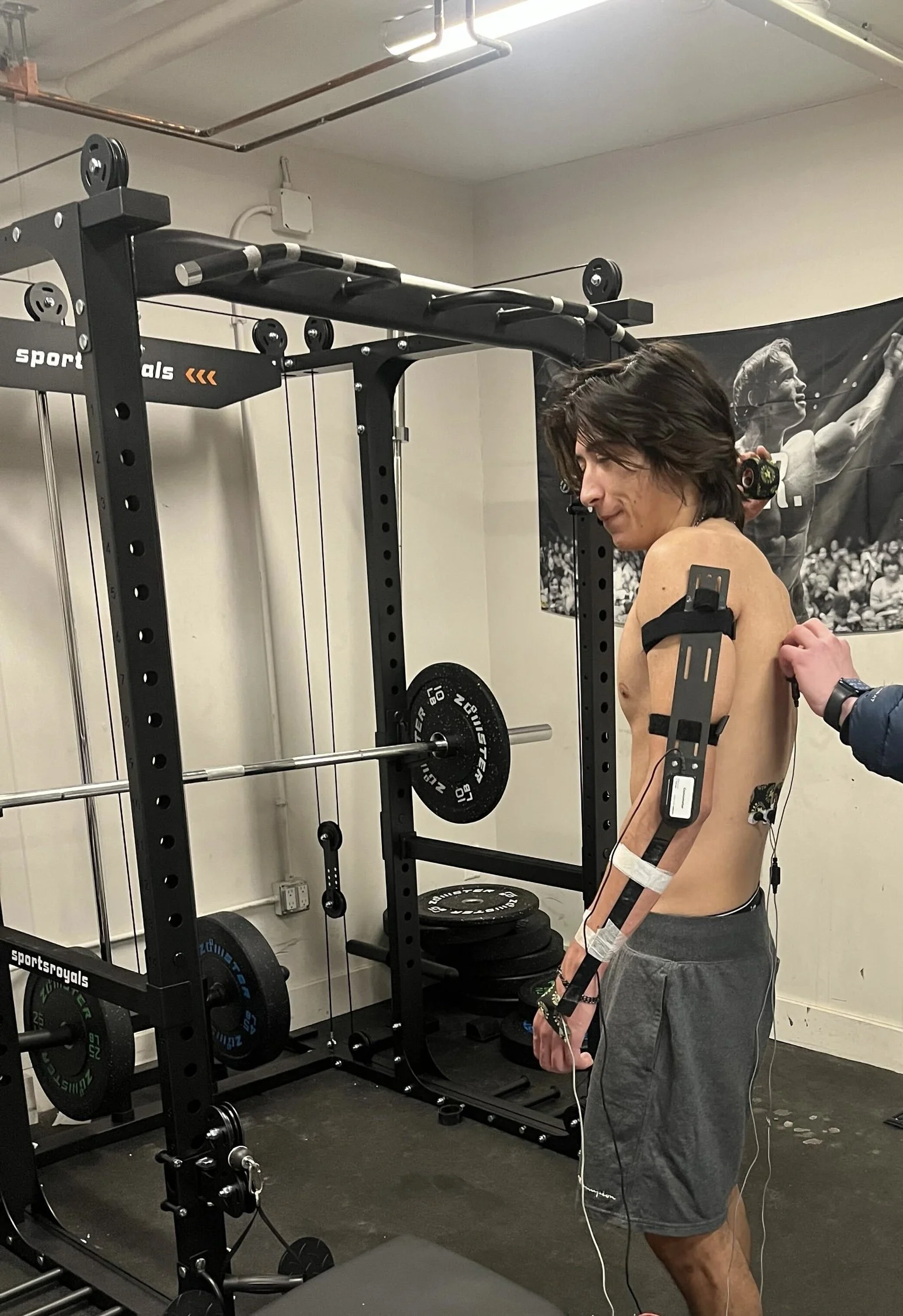
Me before preparing all of the sensors before trials
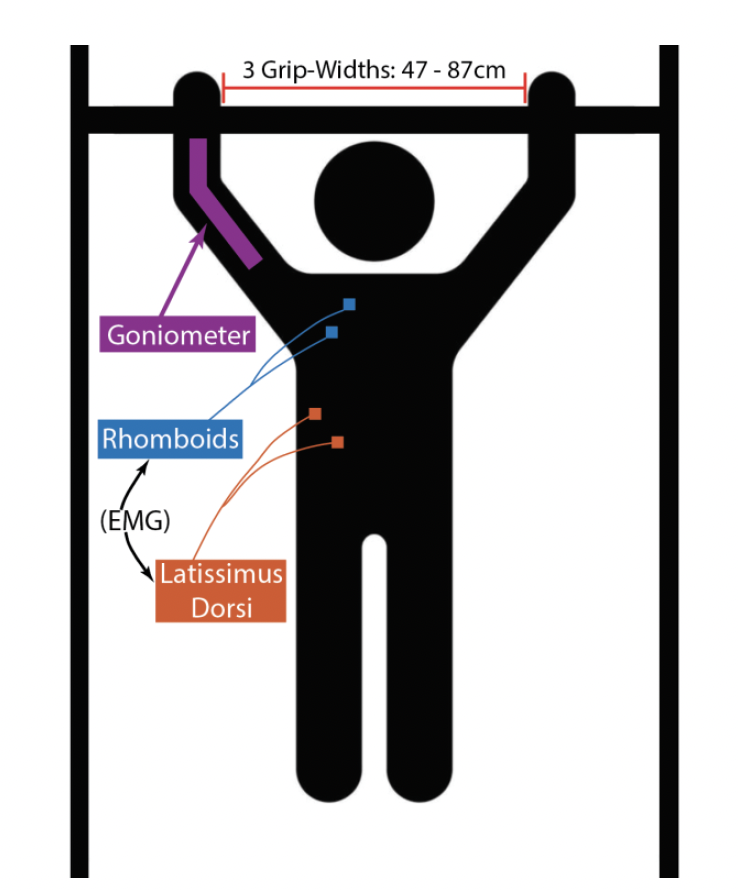
Graphic of my testing setup
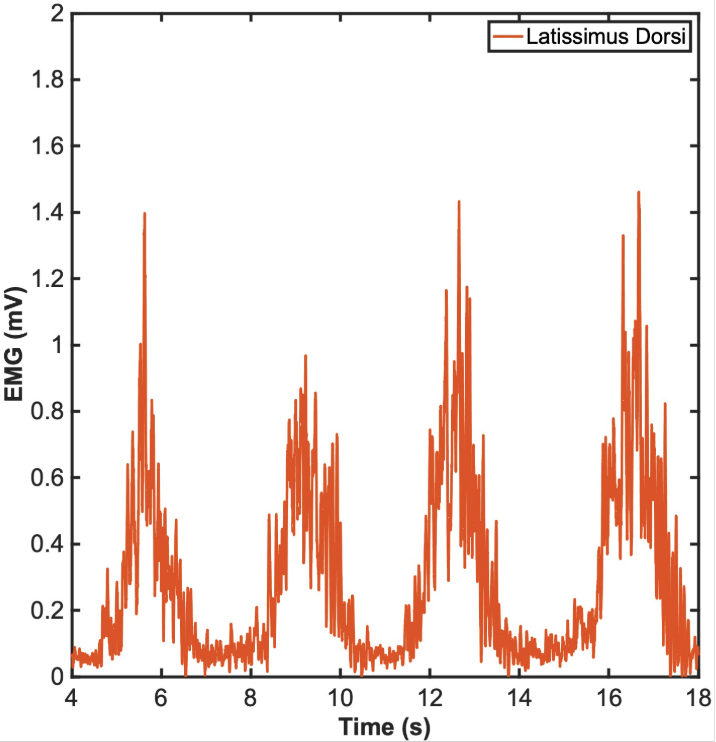
Example of EMG data collected for one muscle group
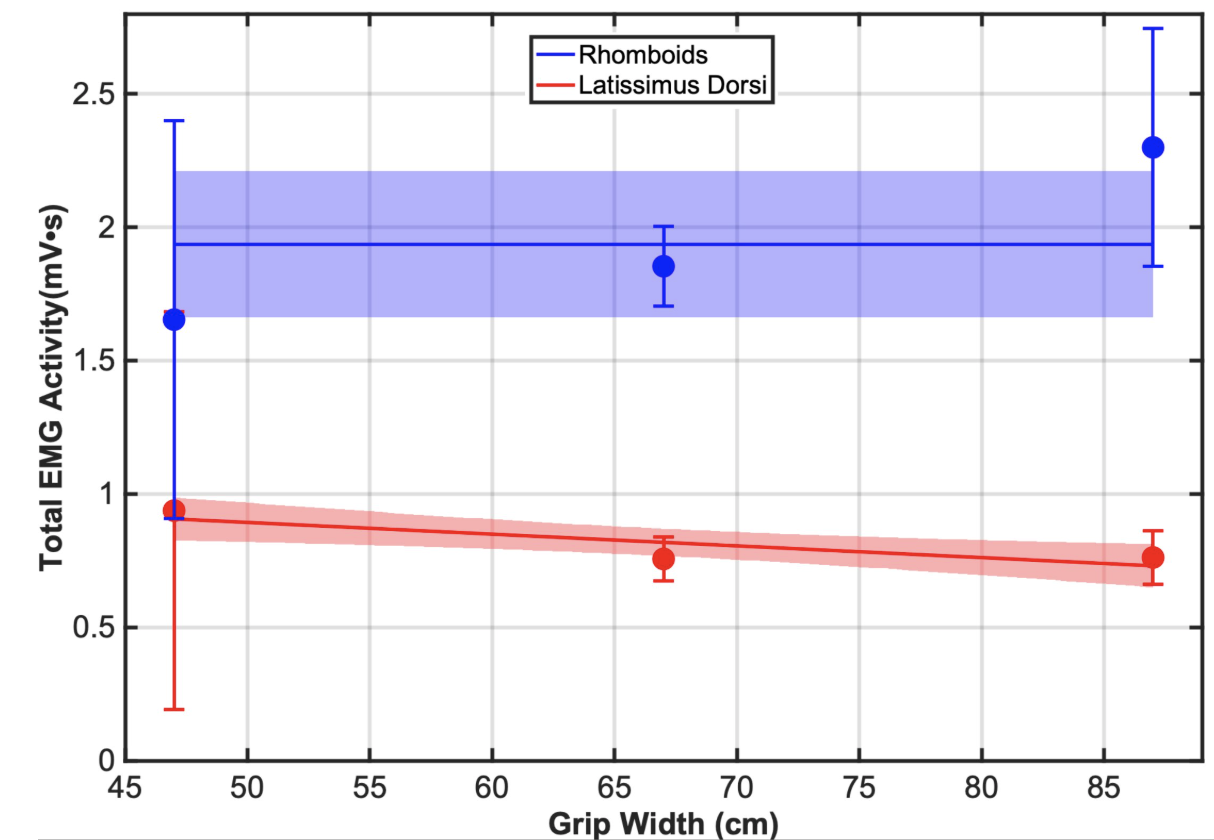
Final graph showing correlation between width grip and muscle activation for the two muscle groups
Data Analysis
After performing the experiment, I was left with raw EMG data. The raw data were converted into average rectified values (ARV) by calculating the absolute values of the EMG signals and applying smoothing to determine the ARV for each pull-up. I used the goniometer data to determine the times for the start and end of each repetition, allowing me to have an interval for each repetition. With these two sets of data, I ran a MATLAB script that calculated the integral of the ARV data during a repetition to give me total muscle activation. I then used a separate MATLAB script to plot the data for both muscle groups to determine if there was any correlation between changing width grip and muscle activation
Poster Presentation & Findings
My experiment found that for rhomboids, varying width grip had no statistically significant effect on muscle activation, but increasing width grip had a negative correlation with latissimus dorsi activation. This result makes sense, since increasing width grip wouldn’t have a large impact on stabilizer muscles such as the rhomboids, as you aren’t changing the stability of the movement. The decreased activation in the latissimus dorsi when increasing width grip is most likely attributed to a different muscle group taking on more of the work. The exact muscle group that had increased activation during this experiment is not known, but it can be hypothesized that biceps have a greater activation in wide-grip pull-ups.
My findings show that to have a greater activation in you lats, you should use a narrower grip. I guess my coach was wrong!
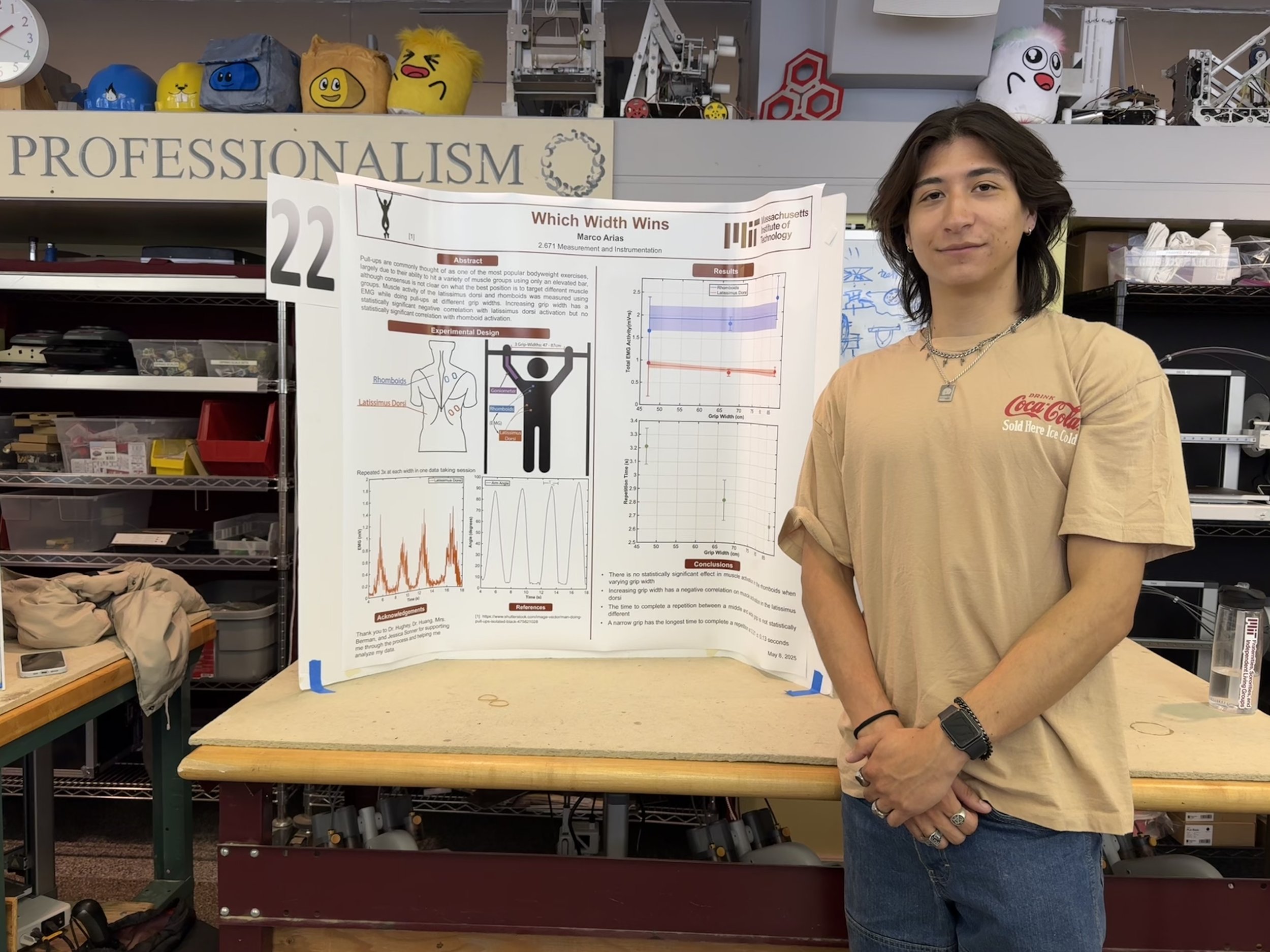
Me presenting my findings at a poster session
My Takeaways
This was one of the most unique classes I took as an undergraduate, since it was one of the few classes that didn’t require me to build or fabricate anything. It was a very different change of pace that I appreciated, and explored an area of mechanical engineering that I hadn’t have much experience in. When people think of mechanical engineering, building structures or products is usually what comes to mind. What’s often neglected is the data analysis portion of mechanical engineering, which is really enjoyable in its own way. Taking on an entire research experiment by myself helped me become comfortable with experimental design and analysis. Being able to dive deep into a topic I found fascinating was a great way to immerse myself into a more research heavy area of mechanical engineering, opening the door for me to pursue research more in the future. In addition to the experimental design, I gained experience in writing a research paper for an academic audience, something that I had little experience with at the time. With the final paper and poster, I was able to strengthen my ability to convey technical topics to a variety of audiences in a way that was captivating and understandable.